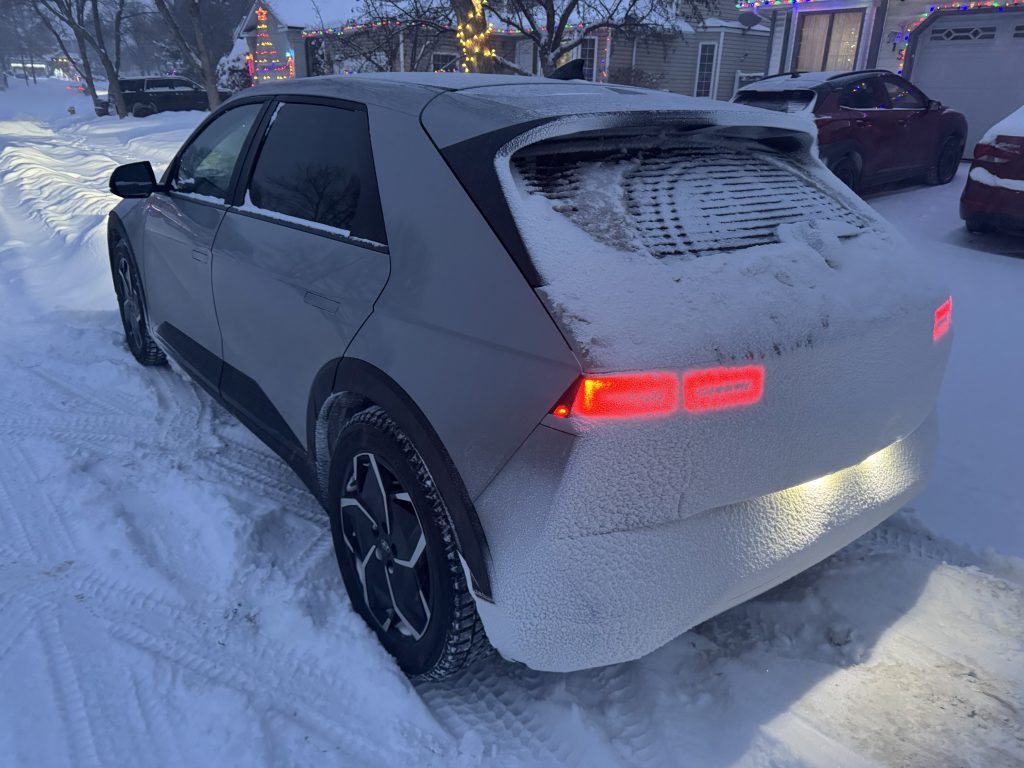
As many know, I purchased a 2022 Ioniq 5 SEL LR AWD in September. From a driving experience, it’s been such a huge upgrade that alone I would say I have zero regrets.
But many are going to ask – how much has it cost me, actually, to drive the car in the winter? I was curious too! So instead of theory, I ran the numbers on something better: my actual driving data.
Over the last three months, I have driven 1936 km in my Ioniq 5. It’s largely been urban driving, with a few excursions out of Edmonton.
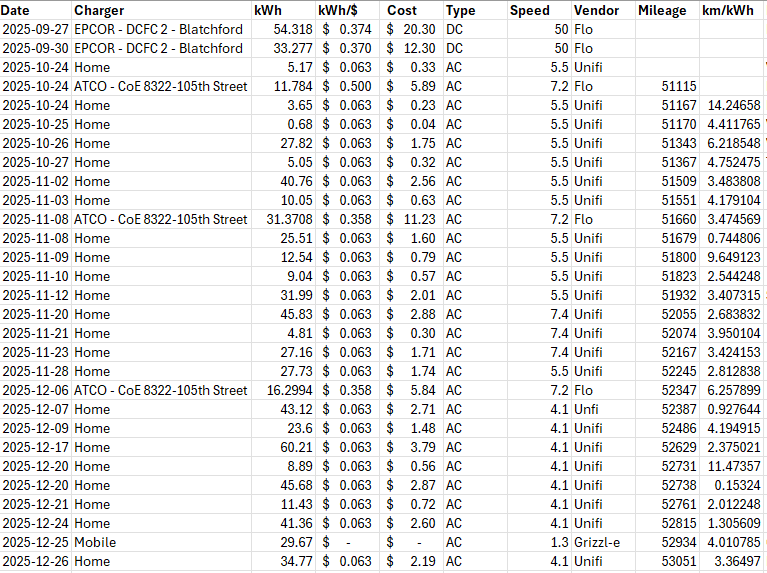
So in summary:
– Distance driven: 1936 km
– Electricity used: 723.57 kWh
– Total cost: $86.96
– Average cost per km: 4.65c/km
Including:
– Cold-weather driving (nearly -30 °C)
– Highway trips
– DC fast charging (the expensive kind)
– AWD and winter tire losses
So, in other words, this is not a cherry-picked “summer, home-only charging” scenario. This is worst-case; it hurts my face to be outside, real-world data in the depths of an Alberta winter.
Keeping this fair, I benchmarked against actual Edmonton gas prices in 2025, using my old car, a 2015 Honda Accord Coupe 2.0L car, without winter tires, a very efficient car in its own right.
– Average 87 gasoline: $1.35/L
– Fuel economy: ~7.5L/100km combined
On a head-to-head comparison, over the same 1936km, the Ioniq 5 consumed $89.96 of “fuel”, at 4.65 cents per km.
The Accord, over the same 1936km, would have consumed $238.67 of fuel, at 10.1 cents per km.
This comes to approximately 5.45 cents/km in fuel costs.
That’s over a 50% reduction in travel costs alone.
This doesn’t account for the fact that I’d need to change the oil in the Accord, possibly the transmission fluid, replace the brake pads and/or rotors much sooner, and other maintenance related to the thousands of moving parts involved in making a gasoline engine work. It also doesn’t account for the fact that the Ioniq 5 has Blizzak winter tires mounted, while the EPA-rated Accord has summer tires. I am confident my 2026 summer numbers will be even more staggering.
We do need to have a little reality check here, though. In the extreme cold that we see here in Alberta, the in-town range is reduced. This is mainly because my trips around town are much shorter than when I leave town, but it is the same issue for gasoline-powered cars.
Once it’s warm, it’s pretty much gravy for both cars. The advantage here over a gasoline car is that, if the EV is still plugged in, it will heat the cabin using mains power (which we know is cheaper than gasoline) rather than the battery pack (as it always does otherwise), thereby protecting the EV’s range. This isn’t always possible, so the EV advantage in pre-heating the cabin is negligible, unless you can plug in at all your destinations.
To recap, these are worst-case numbers that rebut the idea that EVs don’t work in our climate. These numbers prove they do – and still save over 50%, even without factoring in gasoline engine maintenance costs and the EV having high-drag winter tires.
I’m going to continue to gather data through 2026 and look forward to reporting back next December.
31 replies on “Three months of owning an EV in Alberta”
For minor move the ok but long distance sorry. Tour accord 10.1. cl but with a same size suv you would get 8.0 cl and the cost of the suv would be half if the EV. Plus better towing capacity for long range
I drive a Mustang Mach E. I figure I’m also running at about half the cost of a gas powered vehicle. Mine is all wheel drive with all weather tires. That’s good information you are providing. Did you add in the distribution and other extras on your power bill.
Thanks for the question, Arjen. I didn’t include D&T because those are variable costs depending on where you live. It’s lower in Edmonton than it is in central Alberta, and I’m not sure if or how those fees apply in other provinces.
I was really more interested in the numbers that I can directly control.
If you do not include the appropriate D&T / admin charges is this really a true cost comparison? The price of a litre of gasoline includes all costs to get it to market as well as applicable taxes. I think the operating cost of an EV will still be less than an ICE vehicle but not to the extent you have noted. Just a comment from simply a numbers perspective.
D&T essentially doubles the cost (with some variation depending where you are in the province.) We pay 7.99c/KW and after additional D&T it’s more like 17c/KW. Then again, we have solar and banked $1700 in credit this year to see us through Nov to Feb when we are not overproducing, so we essentially pay nothing other than the interest free Greener Homes loan.
Love this post! ive driven an EV for two winters in edmonton as well and found they are fantastic for our winters
What’s the decline in range -15 – -30? How much more charging do you do, in cold weather?
Thanks for the question, Bruce. Certainly there’s a range reduction in these frigid temps, though I’m noticing the near-instant heat from the climate control means I’m only waiting ~5 minutes to get going instead of 15-20.
I would say that the range reduction is comparable to how much more gasoline I would have consumed with my Accord.
Just out of curiosity what is the difference between insurance for your Honda and Hyundai (per year)?
Thanks for the question, Oleg. Surprisingly, my insurance went down by $300/mo going into my Ioniq 5, and that’s including Collision insurance (my Accord didn’t).
One factor, my former insurance provider left Alberta, so I may be comparing apples to oranges.
Hi Chad
Love your article. I have a 2025 EV Kona and have pretty much the same numbers as you except for the insurance. I went from 126.00 a month with my 2019 gas Kona to 280.00 a month with my EV Kona. Full coverage. I shopped around and it’s the cheapest price I found
We just finished a rather epic road trip (’24 Lyriq) – Canmore to Dratyton Valley to Red Deer and back to Canmmore. 850km in -22C temps. It handled great with the Blizzaks on some very sketchy stretches of road. It was absolutely packed full with 5 adult passengers, all with luggage and Christmas gifts. Even with this extreme level of weight and outside temperatures we only experienced a 35% loss in range compared to summer conditions, which I don’t think was too bad at all. Only downside is our trip to DV we had to stop at the DCFC south of Red Deer to top up, as there is only one DCFC on HWY 22 between Cochrane and DV – which is at the GM Dealership in Rocky. That stretch of HWY 22 is like the bermuda triangle for EVs. Someone would likely make good money setting up a DCFC in Sundre…but then again that stretch is EV enemy territory 😉
You’re Honda 2015 will still be on the road when you’re EV dies. Never offset the cost of the Vehicle.
What is the cost to change your battery, quicker tire wear and the price of insurance.
I too have a 2022 IONIQ 5 but I charge at home with a level 2 in a heated garage. Around town in Lethbridge during the summer I average between 13 to 15 KWh per 100 km. In the winter the economy drops to 19 to 21 KWh per 100 km. So at the best and worst it cost me $.033/km and $.054/km or $.043 per km average per year.
Now, curious how your Ioniq would fare if it was 10 years older from now. Would it be still more cheaper to run than your Accord when maintenance costs like batt replacement takes into effect. Great savings from a new EV, but too early to account for dependability and future costs obviously. Still thanks for sharing your op costs.
Hi Chad!
Great article! Loving our 2024 Ioniq5 in Calgary. Curious, who is your utility provider? It appears that you’re paying 6.3cents/kwh for home charging? I’m paying 8.79 cents/kwh, with Enmax Easy Max. With the variable usage component of the transmission and distribution, rider fees and GST, my actual rate is more like 15 cents/kwh though.
Thanks for this, Chad. Very helpful!
An EV is great in urban settings. It would be good to see what it does at -30 in Alberta for any distance driving. For example from Fort McMurray to Edmonton or Grande Prairie to Edmonton.
Great article.
For comparison, my Bolt euv costs 1/3 the amount to “fuel” compared to my 2019 awd Prius, which averaged 57 us mpg over 56K miles, and that doesn’t take the lack of maintenance into account. Both cars were shod with michelin x-ice tires in the winter.
Appreciate the data collected. I was curious, it is commonly stated that the EV costs more to insure? Would you consider giving that data also? It would be an operating expense that could alter the bottom line.
Hi Bruce, thanks for the question. As I mentioned to Oleg above, surprisingly, my insurance went down by $300/mo going into my Ioniq 5, and that’s including Collision insurance (my Accord didn’t).
One factor, my former insurance provider left Alberta, so I may be comparing apples to oranges.
Hi,
When you says your insurance went down by 300$/mo , that’s alot! Down from how much and more importantly for which car?
thx cheers.
Hey Nic, the Ioniq 5 is $300/mo cheaper with collision coverage than my Accord was without collision.
Uh-huh. Make me wondering Probably u forgot add all the service fee to your electric bill at home. Cause I’m in calgary, if i adds all the fees to it. It bring the price to $0.21/kwh Instead of the actual price.
How do the savings stack up when the battery pack has to be replaced? The accord will need just the oil change, not a 15k bill every 3 years for the batteries and you haven’t even factored in the distribution charges(almost 60% of the bill). The range reduction is not just less charge, it reduces the battery life as well, sorry to burst your bubble, but facts have to be represented properly, otherwise it’s a marketing gimmick
How much for a battery replacement? Did you factor that in kilometer cost?
Big story in Edmonton is that their fleet of 60 electric buses is to be trashed, out of 1000, due to poor winter performance.
I also have driven two winters in Alberta. It took a little learning to get the best out of my 2023 Niro EV but now I’m loving it. Over 95% of my charging is at home on a level 2 charger. I average 350 km’s on a full charge in the winter and 500 km’s in the summer. I did do a one day severe winter test at ’38’C I managed 265 km’s.
I also did a road trip to Abbotsford BC, just over 1,000 km’s. It took me 13 1/2 hours, including charging and rest stops. That cost a total of $46 at the expensive public boutique charging.
44,000 km’s, rotate tires and add washer fluid.
So yes going electric is a no brainer.
Hey! Thanks for your thoughts.
I have a few questions for you.
You said this is a ‘22 is it a N? None of the older models I have seen have a rear wiper.
Also, how did you find that the car has faired on our crazy snowfall this year? I imagine with the slippery roads adjusting the regen to nearly 0 helps to not start sliding.
Have you estimated whether these savings justify the extra capital costs, with or without government subsidies?